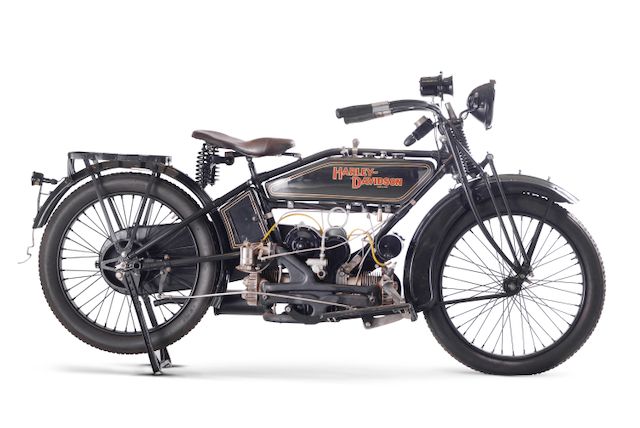
Harley Davidson Sport Twin 1919

| Hersteller | Harley Davidson | Spielwerte | |||
| Typ/Model | W Sport Twin | Trefferpunkte | 18 | ||
| Motor | Boxer, längsliegend | ||||
| Hubraum | 584 ccm | Cubic Inches | 37 | ||
| PS | Sechs | ||||
| Gänge | Dreiganggetriebe | Beschleunigung | 11 | ||
| Geschwindigkeit | ca 160 km/h | Bremskraft | 7 | ||
| Gewicht | 120 kg | Maximaltempo | 12 | ||
| Baujahr | 1919 | Sitzplätze | 1 | ||
| Eigentümer |
In 1919, the 37 cubic inch opposed twin cylinder was introduced which gained popularity overseas. Unique, not only for the cylinder configuration, which was directly opposed and flat but it was uncommonly quiet. Harley-Davidson’s horizontally opposed model W-Sport Twin was introduced, it was a 36ci (584cc) twin with an integral 3-speed transmission.The fuel tank carried 2.75 gallons (10.4 liters) of gas and two quarts of oil. The only rear suspension was that of the springs under the seat. The horizontally-opposed twin was considered to be an „unusually“ small displacement for Harley-Davidson, though it gained great popularity in Europe. It’s engine revved to very high speeds.Easy accessibility for maintenance was a major focus for the motorcycle’s design. The Sport also used a fork unlike other Harleys, where the lower links were connected by rods to the upper links using a central spring. The fender was attached to a Merkel-style truss fork, which was stationary as the front wheel moved up and down. Roller bearings supported both the crankshaft and connecting rods and a geared primary drove the wet clutch and magneto, mounted on top of the engine. Other than the horizontally opposed engine, the Sports could distinguished by their large external flywheel.